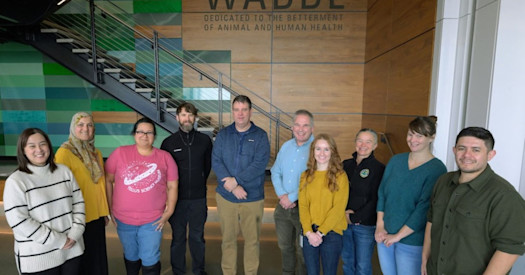
Riddhiman Garge: 'The research is telling us things that might be happening in the embryo. And we can leverage these insights to model disease states, and identify new biology specific to development.'
[Editor’s note: BBI’s Riddhiman K. Garge, Ph.D., a post-doctoral fellow in the Shendure and Starita Labs, is a co-corresponding author of “The proteomic landscape and temporal dynamics of human and mouse gastruloid development,” published online April 24th in the journal Nature Biology. Here, Garge discusses how the paper came about, its findings, and implications for future research.]
How did this paper come about?
It’s pretty interesting story. This paper stemmed from writing this idea out on a napkin with Nobu (Nobuhiko Hamazaki) when he was a post-doc in Jay Shendure’s lab. The idea, essentially, was: “We are really good at looking at RNAs in stem cell-based models of development. But we are not good at looking at what proteins are doing.” Unlike for RNA, in proteomics you need a lot of starting input material, which is hard to come by, particularly in early embryonic development. With gastruloids, we had a scalable model where we thought we could leverage it to gain insights into the proteomic landscape of early development. It ended up getting more and more exciting. I reached out – in a “cold email” – to Dr. Devin Schweppe at the UW Department of Genome Sciences. He responded almost immediately and was pretty excited. His lab develops mass spectrometry-based approaches to study proteins at scale, including new instrumentation, new software, and new biology. It seemed like a good mix.
Please explain more of the background of this in the context of embryonic development.
We can identify and catalog the RNAs, but at the protein level, we almost have no idea what changes are occurring when stem cells differentiate into cell types, particularly in the context of early embryonic development. These models mimic features of embryonic development. And we cannot study features of embryonic development in vivo, because of obvious ethical and technical challenges. So, our goal was to build a resource and leverage that resource. Not just RNA, but more importantly, looking at the protein level in an experimentally-matched fashion. We asked how RNAs and proteins change over the course of both mouse and human gastruloid development. And used that data to generate new hypotheses of new systems that are relevant in the context of development, including insights into genes that we potentially did not know had roles in development.
Even with pilot tests comparing two developmental stages in human gastruloids, we were seeing interesting changes at the protein level. That warranted us to go back and say, “Let’s systematically profile both mouse and human gastruloids.” And do it across time points that roughly mimic pre-implantation – when the embryo is a ball of dividing cells to shortly after gastrulation, where the embryo breaks symmetry and establishes the body plan via the emergence of differentiated cell types .
We wanted to be systematic about it, so we profiled proteins and RNA, enabling us to compare how their levels change over gastruloid development. From our data we can see systematic processes where protein and RNA levels are discordant and instances where they are not. Interestingly, those are not random. They tend to be specific to certain biological processes, such as metabolism, which tend to be anti-correlated, (i.e. where the RNA level is discordant with the protein level).
What happened next in your research?
So, we uncovered a new level of regulation when we started sampling the proteins during gastruloid development. We took these datasets and built protein networks and predicted which sets of proteins might be functionally related, because they get turned on and turned off at similar times in development. As a result, we built these protein wiring diagrams from gastruloids so can we generate new hypotheses of developmentally relevant protein interactions and functional modules that are underlying early embryonic development. We used this as a mechanism to predict new functions for proteins and also to nominate disease candidates. Because if you’re seeing a set of proteins that are associated with known diseases genes that are important for development – just guilt by association – you can draw inferences of what this gene might do in the context of development.
Then we went one step further: When proteins go through a whole host of modifications once they are made, called post-translation modifications, the most common one is called phosphorylation. With our datasets, we were able to profile and identify phosphorylation sites that tend to be important for gastruloid formation.
You relate your research to the Commander Complex. Please elaborate.
The Commander Complex has been recently associated with developmental defects including X-linked intellectual disability and Ritscher-Schinzel Syndrome, but its effects in early embryonic development remain unknown. Using our guilt-by-association approach, we nominated networks of proteins containing the Commander Complex that were strongly linked across gastruloid differentiation. Perturbing proteins in this network disrupted normal gastruloid development. This is interesting, because our findings now suggest that the Commander Complex plays roles in early development and identifies new disease gene candidates associated with developmental disorders.
More broadly, by using proteomics in gastruloids, we are starting to shed light on a critical developmental stage that we all go through, but until recently, had limited understanding of what was happening. We can make predictions of what the gene expression levels might be, but until we actually measure the proteins, we don’t know. With these datasets, we are now looking across RNAs, proteins, and post-translational modifications, and to infer how genes function not just in one layer, but across multiple layers to execute developmental roles in cells. Moreover, these datasets are just starting point of what we can do. I’m pretty excited about finer cell-type specific resolution, as well as identifying developmentally relevant networks, so we understand the molecular rules of embryonic development.
How would you articulate the thesis of this paper and what does this mean for future research?
I would say our thesis is: We have built a multi-omic resource to discover potentially new biology – and the Commander Complex is a case in point of how we leveraged our resource.
We are leveraging this research to gain insights into development. The research is telling us things that might be happening in the embryo. And we can leverage these insights to model disease states, and identify new biology specific to development.