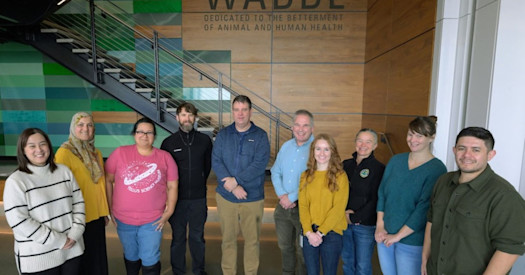
Dr. Maitreya Dunham: 'I would tell my younger self to appreciate your mentors and take them for all they’re worth, or you will miss them when they’re gone. But you can still have echoes of their impact through yourself.'
[Editor’s Note: Maitreya Dunham, Ph.D., Chair of the UW Department of Genome Sciences, participated in the 9th Annual Mutational Scanning Symposium, March 25-27, in Melbourne Australia. Here she discusses the conference, as well as the future of genome sciences.]
After participating in the 2026 MSS, which, if any, any presentations were especially informative, or even inspiring?
Two presentations stood out for me. First, in the one by Sujatha Jagannathan at University of Colorado, “Single-codon resolution mapping of nonsense-mediated mRNA decay via genomic stop codon scanning of LMNA,” I felt like we were learning real biology, something new about how things actually work. The other presentation was the talk by Fritz Roth of the University of Pittsburgh, entitled, “Landscapes of using AAT missense-variant effects reveal pathogenetic variation and genetic suppressors.” It was with a drug company and I was interested in how that company actually use suppressors. Suppressors are such a classic method to learn how genes work.
Based on what you learned and observed at the symposium – as well as your own research and collaborations – how would you characterize the future of genome science?
One thing I took away on the future of genomics is that the world is our oyster. If you can envision it, and build it, these are things we can do to tackle really hard questions and, thereby, create the future of genomics, biotechnology, and other related fields. Moreover, any time is the best time to be in this field. We are constantly on the verge of understanding more and more things, using more and more tools, with more and more accessibility of those tools.
The Mutational Scanning Symposium continues to emphasize that and it represents an important element in the future of genome science. It is such an interesting meeting because it is about a scientific method, as opposed to a biological process or a model organism. It is so broad in terms of how people are applying technology to their own interesting questions. I saw people thinking about those hard questions on things we do not understand about genetics, like penetrance, and genetic background dependence, and environmental context. These are among some of the hard questions people are able to approach.
One thing I especially like about this particular community is the data sharing. We have all this data now that anyone can get. And all these resources, such as MAVE DB, make data all the more accessible and organized. Having standards around how to share data is another important advancement in making data increasingly more useful.
Another key question for the future is how do we teach students to prepare for a field that is constantly changing. It was great to see trainees at the symposium, and to hear about their creative projects. It also raised important questions: “How can we make their lives easier?” “How can we get then up to speed so that they are able to make important contributions?”
How might the advent of synthetic biology, as evidenced by the prospect of “genome writing” as opposed to “genome editing,” shape this future you envision?
We all appreciate the interplay between basic science and understanding the concepts of “Can you build it?” ”Can you engineer it?” “Can you make it better?” The ultimate test of whether we understand something is if we can design it. And that represents a big gap.
You entered MIT as an undergraduate student in 1995. Decades later, with the knowledge you have gained, how would you advise a younger Maitreya Dunham as she embarked on a career in science?
I would say to my younger self: “In the lab, doing controls is always worth the time.” Circa 2002, there was a control experiment that several of us thought another person had conducted. It cost me a year of evolution experiments, because there was a typo on a media recipe that none of us caught. Although the typo led to a discovery by another postdoc in the lab who followed it up and tried to understand it. Turning lemons into lemonade.
I landed in the Department of Genome Sciences at the time when Stanley Field’s lab and Jay Shendure’s lab were coming up with saturation mutagenesis coupled with high throughput sequencing concepts. Being at the right time and in the right place really mattered for me.
Also, looking back, I have such an appreciation for my mentors. I wish I had spent more time with them and asked them more questions. I did not envision myself becoming a department chair, so I was not paying enough attention to how scientific leadership works. My Ph.D. advisor David Botstein at Princeton recently died, and I can never go back to him for advice. Same with Angelika Amon at MIT. She was such great collaborator and mentor. And of course, Debbie Nickerson here in UW Genomic Sciences. Her absence is still felt and I find myself saying, “I wish I could ask Debbie for advice.”
I would tell my younger self to appreciate your mentors and take them for all they’re worth, or you will miss them when they’re gone. But you can still have echoes of their impact through yourself.